Role
01 · NETSOL Technologies
Enterprise finance, simplified
Designing clear workflows for an automotive-finance platform that connects lenders, dealerships, and customers in one unified ecosystem.
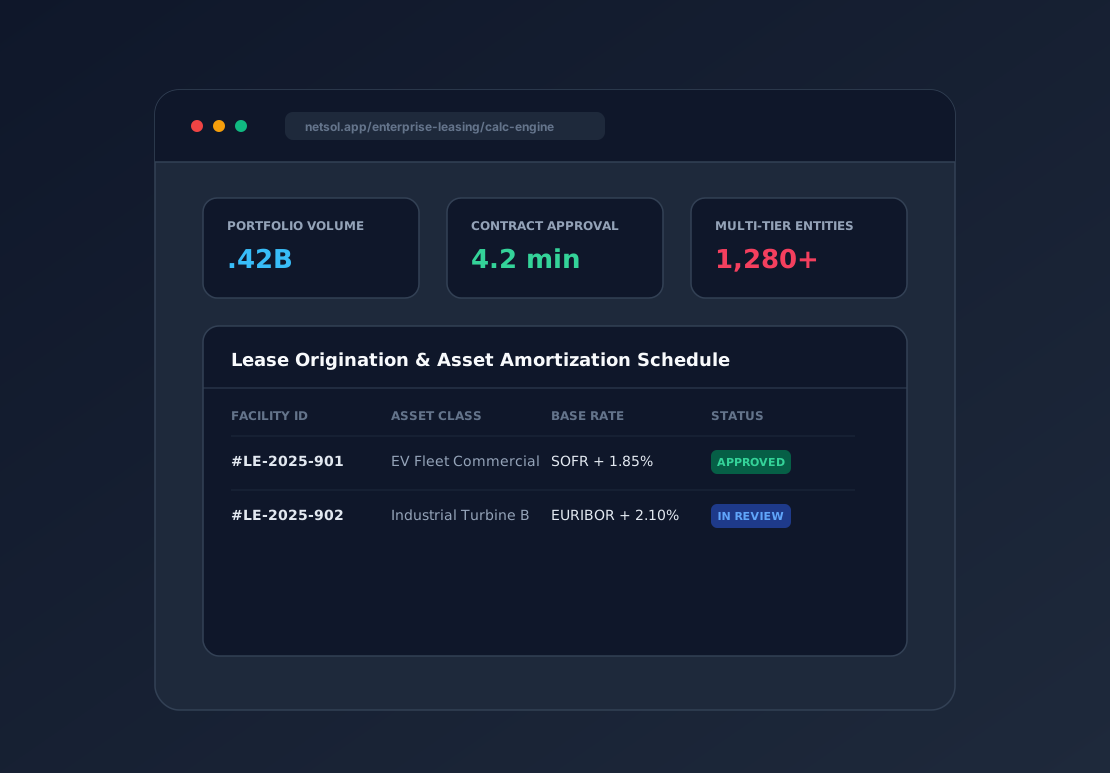
Enterprise clarity is built from careful decisions, not decoration. Leasing and finance products carry dense rules, operational dependencies, and specialist terminology, so each role needs a clear view of the same underlying process.
Senior Product Designer
Focus
UX strategy & end-to-end design
Period
2025—Present
Type
Enterprise B2B · Automotive & Asset Finance
Context & core problem
I lead UX strategy and design on an enterprise automotive-finance platform that connects dealerships, commercial lenders, and end customers into a unified digital ecosystem. Leasing and asset-backed finance transactions carry layered underwriting criteria, multi-party compliance approvals, and complex financial calculations.
When teams rely on fragmented spreadsheets, disconnected portal tools, and unstructured email chains, turnaround times drag from hours into weeks. Each participant—dealership finance manager, institutional credit underwriter, or retail borrower—needs an unambiguous, role-specific vantage point over the exact same underlying deal lifecycle.
The scope of my work spans multi-role origination journeys, credit decisioning surfaces, document-handling moments, status indicators, and customer-facing digital signatures—described here at an NDA-safe architectural level.
Stage 01 · Dealership
Application & documentation
Customer intake, vehicle valuation, asset configuration, and identity document uploads.
Stage 02 · Lender
Underwriting & decisioning
Risk scoring, policy compliance checks, conditional stipulations, and credit approval.
Stage 03 · Customer
Terms review & e-sign
Transparent payment schedules, fee breakdowns, digital contract signing, and status tracking.
One shared finance process, shaped into role-specific views and clear handoffs.
I translate complex operational and financial requirements into intuitive end-to-end user journeys, interaction models, high-fidelity prototypes, and buildable systems. Key areas of ownership include:
- End-to-end journey architecture: Mapping multi-party roles, touchpoints, decision trees, and exception paths across the entire asset financing lifecycle.
- Information architecture & density control: Transforming data-heavy screens with dozens of financial inputs into progressive, step-driven interfaces with ambient status cues.
- Prototypes & interaction systems: Building realistic Figma prototypes to stress-test complex workflows with business analysts, solution architects, and institutional stakeholders.
- Cross-functional execution: Collaborating closely with product management and engineering leads from discovery through technical refinement, QA review, and release.
I begin by making the operational model transparent: Who acts? What critical data points do they need to make a decision? What constraints govern each step, and where is the workflow most likely to stall?
Once the operational rules and decision hierarchy are established, I design the interaction model and state machines before moving into pixel-level styling. This structural focus ensures that edge cases—such as document rejections, credit counters, or manual overrides—are accounted for gracefully from day one.
A shared, dependable model for users, product teams, and engineering.
The result is a direct, predictable path from complicated financial requirements to buildable software behavior. Reusable interface patterns for status indicators, tables, and document queues help multiple enterprise modules maintain structural consistency while drastically reducing developer implementation overhead.
Confidentiality notice: Specific client institutions, proprietary rate calculation models, and production dashboards are protected under non-disclosure agreements. This case study illustrates architectural thinking, UX methodology, and interface systems without compromising proprietary data.